Codling moth controlled in pipfruit
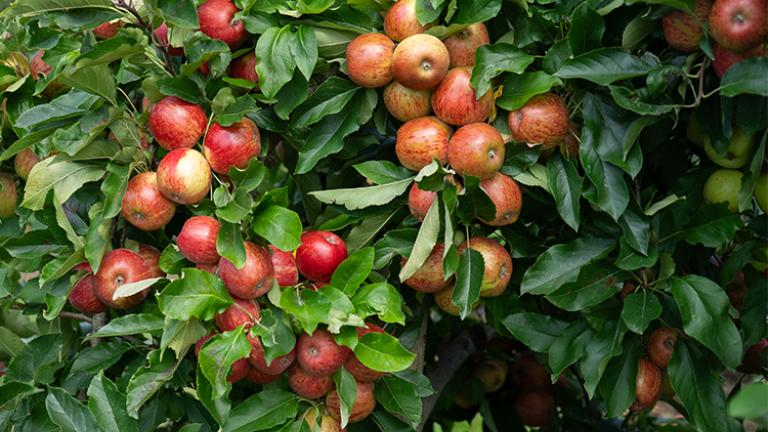
The tight control of insect pests like Codling moth, in pipfruit orchards, is important to maintain our favourable market access status with countries that import our apple and pear crops.
“Not being able to export to key markets has considerable financial implications for growers and they need to be vigilant about controlling Codling moth, in particular” says Dean Perry, Syngenta Technical Sales Manager.
New Zealand Apples & Pears Incorporated (NZAPI) issued a reminder to growers in 2021 about the definition of an at-risk production site based on an insecticide programme, which was:
- No insecticide application targeting the second generation of Codling moth (700-780 growing degree days) was applied; and,
- There is a gap in the insecticide programme greater than:
- six weeks where mating disruption has not been used; or,
- eight weeks where mating disruption has been used.
Dean says, “A robust Codling moth control programme starts with the mandatory application at Biofix plus 80 to 110 growing degree days (from the Codling moth phenology model), using specialist lepidoptera insecticides.
“Then, to bolster mid-to-late season Codling moth control, the recommendation is to respond to trap monitoring thresholds. Trap monitoring is a requirement for growers sending fruit to Codling moth sensitive markets, such as Taiwan, to comply with Ministry of Primary Industry rules and regulations.”
Two insecticides that fit well in mid-to-late season use patterns are VOLIAM TARGO® and PROCLAIM® Opti. Both have high efficacy against Codling moth and have favourable pre-harvest intervals.
VOLIAM TARGO® is a combination of a chlorantraniliprole (Group 28) and abamectin (Group 6) and is registered for the control of Codling moth and Leafrollers in pipfruit. It works at three different stages of the Codling moth and Leafroller lifecycle, targeting:
- eggs when laid on treated leaf surfaces or sprayed over (ovicidal)
- larvae as they feed on their own eggshell when hatching (ovi-larvicidal)
- already-hatched larvae by contact or ingestion, meaning they stop feeding within minutes.
PROCLAIM® Opti, a Group 6 insecticide, is also registered for the control of both pests. Codling moth and Leafrollers can produce multiple generations each season, so they need to be managed from spring until harvest in autumn.
Dean explains: “VOLIAM TARGO® is selective to Codling moth and Leafrollers. Thanks to its combination of two active ingredients, it helps bolster Codling moth resistance management strategies. Both active ingredients are taken into plant tissue, making it rainfast and able to provide long-lasting control.
“PROCLAIM® Opti is a new, enhanced formulation of emamectin benzoate that produces less dust than the conventional granules to improve its handling, user safety and application properties. When added to the spray tank it goes into solution quickly.” <view the video here>
Best practice is to position a VOLIAM TARGO® application mid-season to take advantage of its high efficacy during three Codling moth life stages. Refer to diagram 1 for guidance on product timings.
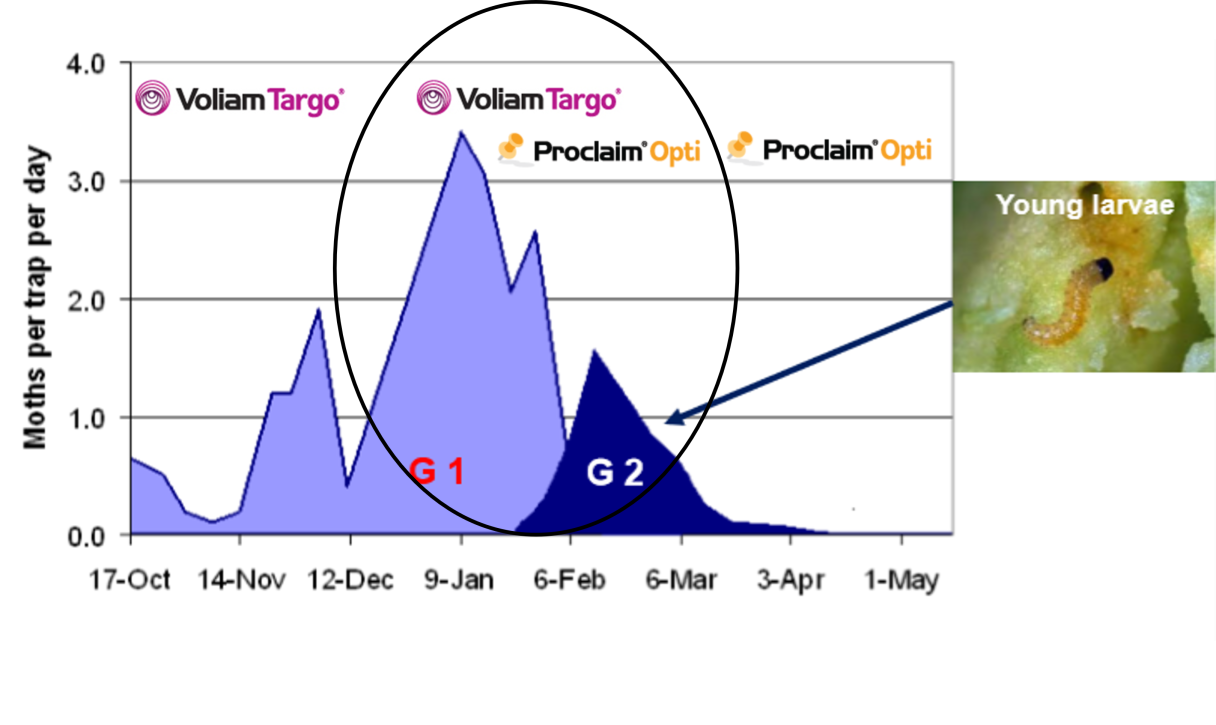
PROCLAIM® Opti is better suited to pre-harvest applications due to its very short, nil residue pre-harvest interval (PHI) of three days. “ Please talk with your exporter and refer to the NZ Apples and Pears PHI database on their website for any updates to this.”
For more information download the VOLIAM TARGO® Technote and/or the PROCLAIM® Opti Technote or contact your local Syngenta TSM.